Friday, April 29, 2011

Light Exposes Things For What They Really Are


This week, we're studying Ephesians 5:1-20 for our life class at First B. Verse 13 says, "But everything exposed by the light becomes visible—and everything that is illuminated becomes a light." In the Bible, there are lots of instances where Christians are called to be a light. This means different things in each context, but in this context, it seems like we are called to reveal things for what they are. 


Christians believe in absolute truth and in this verse, Paul is telling us simply to reveal the truth. That's a pretty powerful idea that all we need to do is reveal the truth and it will do the rest. We don't have to act like salesmen, making some pitch to someone in order to trick them into believing us. We simply need to say the truth.


An example that Tim, our college pastor, brought up one time was the Dos Equis commercials with "The Most Interesting Man in the World." At the end of the commercial he says, "I don't always drink beer, but when I do, I prefer Dos Equis." He doesn't claim it's the best beer in the world. He doesn't claim he refuses to drink anything else. He just says he prefers it. That's pretty truthful and Tim brought up the point that people don't want to hear a gimmick, they just want to hear an honest opinion. That really applies to our calling to be a light. We are to reveal things for what they are in complete truthfulness. 


One area where we desperately need to accurately reveal the truth is in sin. There are two ways to reveal sin: reveal someone else's sin or reveal your own sin. We are often tempted to only do the first and skip the second. But no, we need to reveal our own sin for what it is. I'm not saying to shout it out to everyone that you're living in sin, but I am saying that you should be very ready to reveal your sin for the sake of glorifying Christ. By revealing our own sin, we can more accurately portray the truth of sin. And as the verse said, everything that is illuminated becomes a light. God can even use sin to bring himself glory. By accurately illuminating the truth of sin, we can more accurately show God's love to others.


Christians are often bad at that, specifically with homosexuality. Christians believe homosexuality is a sin and that's not news to anybody. But the problem lies when we make it out to be something much worse than our own sins that we struggle with. If we're going to preach that homosexuality is a sin, we have to preach it truthfully. It is a sexual sin, that in God's eyes is no different from cheating on your wife, premarital sex, or pornography. Making homosexuality out to be something horrendously worse than other sins is not truthful and completely unhelpful.


In all of this we need to keep in mind that we are not the source of light, but that God is. We have to ask the question, "Is this God revealing the truth through me or am I revealing something for my own agenda?" We should look for the truth ourselves and should reveal the truth to others all for the simple goal of knowing God. If we really know God and his truth, good things will happen.

Thursday, April 28, 2011

Why Math > Science


It's probably disheartening for my friends in the field of science to hear that I say Math > Science. After I explain myself I believe my scientist friends will be in whole-hearted agreement.

Everyone knows that math is pointless without science. Who really gives a darn if 1+2=3? Who cares what the solution to the differential equation x''(t)=c x is if they don't know what the heck a spring is? You know who invented calculus? Isaac Newton. That's right, a physicist. Who invented the Fourier transform? Joseph Fourier, a physicist. The list goes on, but you get the idea. Nobody cares about math by itself.

Unless you study one of the lame sciences, science is completely dependent on math. As a physics major, I almost have enough experience doing math to be a math major. The only way a physicist can predict anything is to do the math. So science is completely dependent on math.

Math needs science and science needs math.

Some people have wondered why I'm getting certified to teach math and not science. I majored in physics, so I should teach physics, right? Wrong! There are two reasons I do not want to get certified in science: Biology and Health/Human Growth and Development/Sex Ed. The problem with getting certified in science is that there is only one science class I'd really be excited to teach and that's physics. I'd tolerate Astronomy, Chemistry or Geology. I would die if they forced me to teach Biology or Health. And once you're certified in science, you're qualified to teach any science class. That means that if you find yourself in a school with a less than cool principal, you may get stuck teaching a class you hate.

Math, on the other hand, is much nicer. There's Algebra, Geometry, Pre-Calculus, Calculus, and Statistics. I'd be happy teaching any of these classes. There is not a single math class that I can think of that I wouldn't want to teach at the high school level. Therefore I say Math > Science because it helps my job possibilities and prevents me from being forced to teach a lame class.

Besides, students already think math is pointless without application. So who better to teach math than someone who knows how to apply it in really interesting ways than a scientist?

Wednesday, April 27, 2011

Ride, Rant, and Reminisce


The other day I went on a road bike ride up Lookout Mountain road to the Buffalo Bill memorial. It was a great ride. The road skirts along Mt. Zion for a while, passes under the Mines "M" and then goes over to Lookout Mountain. Golden is still brown, so the views toward the city weren't spectacular, but it was still a very pretty ride. There are a few sections where you're riding along a cliff with rocks outcropping. Once you get past the first switchback section, you realize that Mt. Zion is actually a very pretty mountain on the north side. The east side is lame. It's just a hill with an M on it, but the north side has lots of huge beautiful rocks. See this photo album for evidence of the north face's beauty. There are several sections along the road where you can see the rock layers that have been formed over the years. It seemed like the majority of the rock I saw was granite gneiss, so it was lots of pink and dark gray stripes.

I realized that I'm a wimp when it comes to going fast down a windy road on a road bike. Going uphill I was passed only once by a guy riding a $5,000 carbon fiber Cervelo bike, so I wasn't ashamed since his bike probably weighed half the weight of my steel Surly. But going downhill I was passed by three guys. I was ashamed, so I tried to keep up with the third guy for the rest of the way down. I started coming up with excuses as to why I was going slower. "Those guys have less tread on their tires. They probably have better brakes than my cantilevers. They've been in a tuck position and I've been sitting upright." When it comes down to it, I'm just not confident on a road bike when it comes to going fast on a windy road.

There were several road bikers out. I've never thought very highly of the typical road biker. They never smile (which is saying something coming from me). They have ridiculously light bikes that look like they'd split in half if they crashed. They all dress the same: 80 dollar jerseys, Lycra shorts, stupid shoes that are worthless for walking, high tech socks and a helmet they bought for $200. You never ever see a road biker with a backpack of any kind. They always have energy gels and patch kits crammed into their backside shirt pockets. They've never once ridden a bike for the sake of transportation. Their saddles are rock hard, which probably explains why their personalities are stone cold. Anyways, I saw a lot of these people on my ride and remembered that I don't want to be like them.

I also saw some mountain bikers. One was just cruising down the paved road and I shook my head at him for passing up on the opportunity to ride the most fun part of Chimney Gulch trail. Though I couldn't help but be jealous of all the mountain bikers I saw on the trail that cuts across the road a couple times. Mountain biking is wonderful and I miss it. I miss churning away on the uphills and pushing through the rocky sections to see how far I could get. I miss speeding along the smooth single track and hopping off the woop-dee-doos. I even miss that feeling you get when you realize you're going too fast to make the upcoming turn and you just know you're going to crash into the bushes. But alas, I have no mountain bike.

There are three weeks and 4 days until I leave for my bike ride. There's no clear-cut point of no return, but I'm getting pretty close to where it would be if there was one. I bought my ticket to Bellingham. I leave at 9:40PM on Saturday, May 22. I was stressing out about getting someone to take me to the airport early Sunday morning, so I just decided I would bite the bullet and sleep in the Seattle airport so I could leave Denver at a decent time and still have a moderately early start in Bellingham. I'm getting nervous, but I can't wait.

Monday, April 25, 2011

Do What You Do

This last week in the Ephesians class at First B, we discussed the first half of chapter 4. Verses 11 and 12a say "So Christ himself gave the apostles, the prophets, the evangelists, the pastors and teachers, to equip his people for works of service..." Recently at First B, we've been talking a lot about spiritual gifts and how every Christian has a spiritual gift and how everyone should use their spiritual gift.

One problem that a lot of churches have is that they need someone to fill a position so people step in because no one else will. So what's the big deal? The problem is when they step in with no real gift in that area. You end up having a whole bunch of people serving in the wrong place. It's the equivalent to placing a body's eyeballs where the feet are supposed to be. It doesn't work. God has given us unique gifts so we can all serve him uniquely in our own way. He has also given us unique passions that we should pursue in order to magnify God. I think that is one of the most beautiful things about the church and it really gets wasted when people feel forced to serve in areas they don't care about or are not gifted in.

Last Sunday I asked the class, "What are your gifts and what are your passions? How can you use them to serve God?" The first ones that came to mind for me were teaching, math, and physics. So I had to ask myself, "Am I using my gifts and passions to honor God in a way that really gets me excited about serving Him?"

Recently it seems like God has really been calling me to teach high school math and/or science. I think I'm gifted in teaching and I have a strong passion for math and science, so it fits. Since I moved into my new place in Denver, I've learned a lot. One thing I've learned is how much influence adults have on kids. It is tragic how much a bad parent can damage their kids and it is inspiring how the good ones have such a positive influence on their kids lives. As far as non-family members go, teachers have a pretty strong influence on the kids in their classes. It's hard for me to picture exactly what teaching will be like, but I definitely want to make a difference in people's lives and I think I could do a good job doing that in a high school.

I've always been interested in teaching. In high school I helped friends with homework and tutored one girl for pay. I had an enormous sense of satisfaction from doing that, so I knew I would enjoy teaching. Pursuing teaching seemed kind of dumb to me at the time. It seemed like it was just promoting an academic cycle where people go to school, then teach kids that go to school, who go on to teach other kids... I felt like I had to help society "progress" by helping develop technology and expanding scientific understanding. My thinking evolved though. School is much more than learning factual knowledge. There is a lot of character development that happens in school. So teaching can lead to much greater things than just a bunch of engineers, businessmen, and accountants. It can lead to training students to have a wonderful influence on others.

I also knew that teachers don't get paid much. The ole' School of Mines made sure I got out of there with no less than tens of thousands of dollars of debt. This much debt leads to very high monthly payments. I thought that I wouldn't be able to afford a high school teaching job because of my loan payments. Well I was fortunate enough to score an awesome job doing research at Mines for a pretty small amount of money. I realized that I could do this. I could have a low paying job and still make all my payments. That eliminated my financial worries with teaching high school.

All my concerns cleared up and I realized that I can do this. So I am pursuing a career in teaching high school math (and maybe science in the future). God has given me gifts and passions in this area and it's hard to predict what it will be like, but it's an adventure I'm excited to jump into.

Friday, April 15, 2011

Rocky Mountain Spring Water


You know all those Coors commercials that talk about how they use fresh rocky mountain spring water?


One out of every five people tubing down Clear Creek pee in the water to keep warm.

It's almost tubing season!

Wednesday, April 13, 2011

Office Physics: The Laser Pointer

The original laser pointer

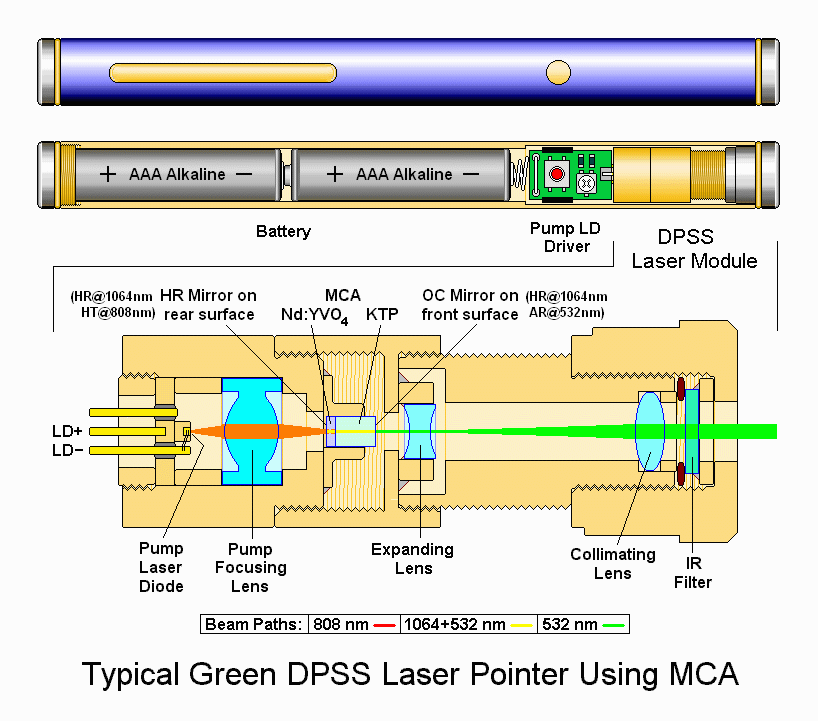
Back in the days of star trek, the laser was first discovered. They were first used as weapons for obliterating alien space ships. Much like guns, they had amazing accuracy, which was valuable for combat and lecturing. In the ancient days, guns were used for pointers in the classroom. The teacher would pull out her revolver, and shoot wherever on the board she wanted to point. The accuracy was impeccable, but it caused a disruption in the neighboring classroom the first day it was used and was never used again. From then on, wooden pointing sticks were used even though they were helplessly inaccurate. When laser guns came around one anonymous entrepreneur realized they could be used in the classroom for pointers. Luckily he had spent several years scouring the microfiches of thousands of libraries and came across the story of the teacher using a gun for a pointer. So he decided to make a laser pointer with lower power so as not to damage the young minds he taught. The laser pointer has evolved some over time, but here's a diagram of what the modern green laser pointer looks like:
There are three important parts to a laser.

1. The pump: This just a light with a single color. It could be a laser, an LED, a laser diode, whatever. In the case of this laser pointer, the pump is a laser diode with a wavelength of 808nm. It's effectively just a red light bulb. The light from the pump is sent through a focusing lens, into the resonant cavity.
A laser pump

2. The resonant cavity: The resonant cavity is made of two mirrors and inside the resonant cavity sits a material called the gain medium. If the separation between the two mirrors is right, then one particular wavelength of light will resonate in the cavity and will cause the output light to be very intense. The resonant cavity's job is to allow only one wavelength of light to pass through the gain medium several times, so that you only get one color of light coming out the other side.

A resonant cavity for kids

3. The gain medium: The gain medium is some material that's placed inside the resonant cavity so that the right wavelength of light comes out the other side and it causes the intensity to increase. In the case of this green laser pointer, there's two materials inside the cavity. One is Nd:YVO4, which is used to create infrared 1064nm light. What happens in this step is that high energy (red) light comes in and is absorbed by electrons in the crystal. This left the electrons with a high energy for a bit. The electrons soon decide to release their energy in the form of a photon of wavelength 1064nm. After converting the light into 1064nm, the light goes into the KTP crystal. This is a nonlinear crystal, which means that it acts differently for different intensities of light. Inside the KTP crystal, a process called second harmonic generation happens. This picture shows how it works:

One low energy photon comes in and excites an electron to a higher energy state--an energy of E. Immediately, a second identical photon comes in and excites the electron to a higher energy to an energy of 2E. Like before, this electron decides to relax and gives off a photon with twice the energy of the original photons. This gives a photon coming out that is half the wavelength of the infrared photon, so you get a green light with wavelength 532nm (half of 1064nm).

The green light is expanded and collimated so you get a nice green beam coming out the laser pointer. Tada!

If you made it this far, you probably know more than you ever wanted to know about a laser pointer.

Tuesday, April 12, 2011

A Humbling Day on the Softball Field.

A Note from Banks: If you are a blogosphere n00b, you may want to consider the following options for keeping updated with this blog since I'm not posting these on Facebook for now: Go to reader.google.com and add my blog and your other blogs to your subscriptions-that way you can keep updated on all your blogs by only visiting one site. Or you can put your email in the "Follow By Email" box on the upper right side of this page and every day that I write a blog an email will be sent to you that evening with my blog post.

On Sunday I realized something--softball and baseball are a lot harder than they look on TV. Baseball used to be what I did all summer long and I was pretty good at it for my age. I figured that I could just pick up a bat, ball, and glove and be just as good as I used to be. Not quite the case. In the process of attempting this, I learned several lessons.
  • Bad habits do not go away over time just because you haven't had the opportunity to practice them. In the last 2 years of when I played baseball I started developing a really bad throwing form. It meant that I had little power and quite horrible aim, not to mention looking kind of silly. I thought I could just pick up a ball and I would throw normal again. Well I tried this and still had issues aiming the ball and my throwing speed wasn't superb.
  • Baseball and softball actually take a good amount of upper body strength. After practicing for a couple hours, it seemed like every muscle in the upper half of my body was sore. Yeah, I have no upper body strength now.
  • Holes in the batters box suck. They sucked back in the day and they still suck. I almost want to bat switch so I don't have to stand in the holes.
  • Turns out, I'm actually halfway decent at pitching for slow-pitch softball.
  • Fielding ground balls is no where near as easy as the pros make it look. It's hard to keep track of the ball as it bounces back and forth and it's just unnatural to bend down like that to pick it up. I think infield hits happen a lot more in slow-pitch softball than in pro baseball.
  • Softball fields are ridiculously small. It takes like 2 seconds to get from one base to the next. Pitching is quite dangerous with how close the pitcher stands to the batter.
  • My hitting style is no different from what it was 8 years ago. I was always a lead-off or number 2 hitter and that's pretty much the same way I bat and run today.
  • Baseball and softball are still amazingly fun.