Showing posts with label physics. Show all posts

Wednesday, January 23, 2013

Bouncing X-rays

One of the most interesting parts of my job is a measurement I do everyday called X-ray diffraction (XRD). It's a powerful tool that I can use to tell me about how the materials I work with crystallize. The batteries that I work with work best if the atoms are all lined up in the right direction so it's important to know how they are lined up. There are several ways to change how the atoms are arranged, so we can tune our materials so that they line up properly so that lithium can pass through them correctly.

XRD is mostly useful for crystals. What makes a material a crystal? A material is a crystal if the atoms/molecules are arranged in a periodic pattern. The dots below make a square pattern, so if they were atoms, they would be a crystal.


Or you could arrange the atoms in a different pattern. They would still be a crystal as long as there is a clear pattern to their arrangement. The following is a hexagonal arrangement.


In a complex crystal structure, there may be multiple ways of measuring the distance between atoms. In the picture below, you could measure distances between atoms along the blue line, along the orange line, along the green line, or along the pink line. You can see that the distances are the same for the blue and pink lines, but the distance for the green line is longer, and the distances for the orange line are even longer.


If you know all these different measurements of atomic spacings, then you have a unique way of describing this particular crystal arrangement. For this square arrangement, the atomic spacings are 1, 2.2, 1.4, and 1 for the blue, orange, green and pink "planes" respectively. If you drew similar planes on the hexagonal arrangement, you would see that the atomic spacings are 1, 1.8, 1.1, and 2. So these numbers are unique ways to describe the crystals. So if you had a crystal and you wanted to know what its crystal structure was, all you'd need to do is figure out all the different atomic spacings, look up that set of spacings in a database, and you'd know what the crystal structure was.

The central thing that XRD tells you is what the distance is between atoms, so it provides the way to determine a crystal structure. So how does XRD measure atomic distances? By diffraction. Diffraction is when a wave bounces off a periodic structure. The wave will bounce off the periodic structure and will reflect in a direction that depends on the spacing of the pattern. In XRD, the wave that is used is an X-ray. An x-ray is just light with a very short wavelength. The x-rays I use have a wavelength of 1.5 Angstroms (1.5 x 10^-10 m). Diffraction only works if the distance between atoms is close to the wavelength of the wave. Conveniently, atoms are usually spaced a few angstroms from one another.

If you shoot an x-ray at a crystal, it looks something like this:

One x-ray bounces of one atom and another x-ray bounces off another atom. You can see that the two x-rays travel different distances. The top one travels a shorter distance (2dSin(θ) shorter than the lower one). The difference in paths cause a phase difference between the two x-rays. When they head towards the crystal, they wiggle up and down at the same time. But after travelling different distances, they may or may not be wiggling up and down simultaneously. In the above picture, the difference in paths is just right so that the two waves are wiggling together after reflecting. Waves add together, so you can add the two waves together and see that you get a nice big wave twice the size of the original ones. This is called constructive interference. This means that you would see a bright spot if these waves ran into a piece of photo paper.

But if the difference in the paths was not just perfect, the waves could have ended up deconstructively interfering, which means you would see a dark spot on a piece of photo paper. One way you could get this is by changing the angle that the x-rays come in at.


In this case, you can see that the x-rays are wiggling together on the left, but after they reflect, they are wiggling opposite of one another. If you add those together, you get a flat line, which would result in a dark spot. What this show us is that for a certain crystal structure, x-rays only reflect off at certain unique angles.

The other way that you can change the paths between the two x-rays is by changing the atomic spacings.


In this case, I moved the two planes away from each other, so when the x-rays bounce back up, they deconstructively interfere. What this shows us is that x-rays bounce off at certain angles dependent on the atomic spacing. This is the key to x-ray diffraction. It means that if you see an x-ray bouncing off a crystal at a certain angle, you know exactly what the spacing is between the two atoms it bounced off. Going back to what I said before, if you know all the unique atomic spacings between different atoms in a crystal, you know what kind of crystal structure it is.

When you actually take an XRD measurement, you end up with a graph that looks like this:

Each peak in this graph tells you what angle the x-rays are reflecting at. If you know the angle they reflect at, you can figure out what the atomic spacing is by Bragg's law:


For the first peak in the graph, n=1, the wavelength λ=1.5418, and the angle θ=18.8/2=9.4 degrees. If you solve that equation, you get that the atomic spacing for the (003) plane is d=4.72 angstroms. The (003) plane is analogous to the colored lines that we drew up above. For instance, the blue line would show the atomic spacings for the (10) plane, the red line would  show atomic spacings for the (12) plane, etc. So that is how XRD uses diffraction to determine crystal structure.

Wednesday, April 25, 2012

Throwing a Baseball

Inspired by this tweet,


I decided to do the math and make some pretty pictures to show how angle of release, speed, and air-time relate to each other.

In the first figure, the length of the orange arrows corresponds to the speed of the pitch and the other curves are possible paths that the baseball could follow. If you throw it at a low angle, you have to throw really fast. If you throw at a really high angle, you also have to throw really fast. Somewhere in between is where you would find the minimum throwing speed and it will be close to 45 degrees (not exactly since the ball leaves the pitcher's hand at a different height than it crosses the plate).


In the second figure, the length of the arrows corresponds to the amount of time the ball spends in the air. At a low angle, it spends very little time in the air, but at a high angle, the ball spends a lot of time in the air.


So simple, but so neat.

Tuesday, January 17, 2012

iPhone Pixel, Up Close and Personal


Look at this screenshot I took on my phone. Isn't it beautiful? Good resolution, nice colors, 70% battery life, and almost lunchtime. Everyone knows that a screen is made up of a bunch of tiny little pixels, but most of us have never actually seen an individual pixel. Well that's because there are 614,400 pixels on an iPhone, which means each pixel is about 80 microns wide, which is too small for us to see very well.

In my boredom, I decided to look at my phone's screen under a microscope to see what a pixel looked like. At the lowest magnification, the upper left image in my screenshot looked like this:


You start to see the pixelation, but not very much detail. So I went further.


Now you can see it nicely. Each pixel has 3 segments which shine red, green, or blue. On the top, you can see that only the red segment is on, making the color red. The left has green and red on, so it makes yellow. The right has red and blue on, so it makes magenta. And the bottom has all three on, so it makes white. For completeness, I got the other two corners of the picture.


And to top it off, I zoomed in one more time to take a look at the white region.


So that's what 63 iPhone pixels look like.

How does it work?
(The boring part where I talk about science, so feel free to stop reading)


Each segment in the pixel gives off a certain wavelength of light. Blue is the shortest wavelength and red is the longest wavelength.


If only the blue segment is on, the picture looks blue. The same goes for green and blue. Hopefully that makes sense. If not, I don't know what to tell you.

It starts to get tricky when you start mixing colors. Blue+Green=Cyan, Green+Red=Yellow, and Blue+Red=Magenta. An segment screen makes up different combinations of the three segments to make all the different colors. I'm just going to look at the colors you can make with equal parts of 2 colors.

First, take a look at Blue+Green.


Add Blue and Green and you get Cyan. So you basically see the average color, who's wavelength is halfway between blue and green. That kind of makes sense, but it starts to get trippy when you look at the other combinations. Here's Green+Red.


I don't know about that. Green and red are supposed to make yellow, but Green+Red doesn't quite look like yellow. Even if it doesn't look the same, the color that we see is still at the average wavelength of green and red. Lets look at the last combination, Blue+Red=Magenta.


When you mix blue and red, you see magenta. But the average wavelength of blue and red is 563nm, which is green. Why does your brain do this? Apparently the brain has 2 options. It can either take the average wavelength and make it look like that color or it can make up a brand new color. In the case of magenta, your brain just made up a brand new color. Weird huh?

And that's why I am not a neurologist.

If you want to try to make up crazy spectra and see what color it makes, go here:
http://www.pfk.ff.vu.lt/cie/0_Spectrum_Applet.htm

Friday, October 21, 2011

Baseball and Physics Unite!

If you watched game 1 of the World Series on Wednesday, you had the joy of seeing infrared video. Fox thought it would be cool to bring an infrared camera along with them to St. Louis and it was, indeed, a good idea. Adrian Beltre of the rangers hit the ball down the 3rd base line but he didn't run for some reason. The cardinals threw the ball to 1st and Beltre was called out. Beltre claimed that the ball hit his toe, which would mean it would be an automatic dead ball and would just be considered a foul ball. But the regular cameras couldn't prove the umps wrong.

The regular, real-time video makes it look like the ball didn't actually hit Beltre, but that he just faked it. Yeah, that's possible, but he sure did a really quick job of acting with the way he reacted to the ball hitting his toe.

FOX had demonstrated their infrared camera earlier in the game when Pujols hit the ball into his own foot. The infrared video showed a bright spot on his left foot light up right when the ball hit it.


Being a physics nerd, that was pretty cool to me. But being somebody who always thinks about applications, I didn't quite get the point...at least until the 9th inning.

Beltre was up to bat. There was one out with nobody on base. Beltre was 2 for 3 so far for the night, so he was hot. Feeling confident, he went after the first pitch-a fastball, and never even left the batter's box because he claimed the ball hit his toe. The umps didn't believe him so they called him out. 2 outs. Nelson Cruz was up next and flew out to left field for an anti-climactic defeat.

FOX showed the replay using the regular video and you couldn't see anything that was conclusive enough to overturn the call. It was pretty hard to believe Beltre until they showed the infrared video.


By golly, the ball barely nicked his toe! That should have been a foul ball. He could have hit a home run the next pitch and sent the game to extra innings! Baseball is a game of comebacks. 9th inning, 2nd out rallies can actually happen in this sport. It's part of the reason I love the game so much. The Rangers were only behind by 1 run and the smallest things can make a huge difference. Oh well.

How it works
Infrared cameras are very cool. Infrared light is just like the light you see all the time, just with a longer wavelength, so you can't see it with your eyes. But cameras can be built to detect infrared light. In fact, the last project I worked on was, in simple terms, a color infrared camera pixel.

Infrared cameras are great for night vision because it distinguishes between things with different temperatures. All the things you see around you are emitting infrared light based on their temperature (and emissivity, which I won't talk about for simplicity's sake). The warmer something is, the more intense the infrared light coming off of it is. So when the baseball hit Beltre's toe, the impact warmed up the spot, causing it to emit extra infrared light than the spot did before it was heated up. It takes time for the heat to dissipate, so the "hot spot" stays there for as long as the temperature at that spot is still high.

Why does the high temperature cause the spot to emit infrared light? If you remember my last post about heat transfer, you remember that high temperature means the molecules are vibrating around a lot more. Well the vibration of molecules causes them to radiate. That's exactly how an antenna works. So when temperature increases the vibrations occur at higher amplitudes and frequencies, causing the intensity of the light to increase. You saw the intensity increase when the temperature of Beltre's toe went up.

This effect is called thermal radiation. At room temperature it happens at infrared wavelengths. But if you increase the temperature the intensity increases and the wavelength decreases because of the higher-frequency vibrations. The following graph shows how the emission spectrum changes as you increase the temperature of something.

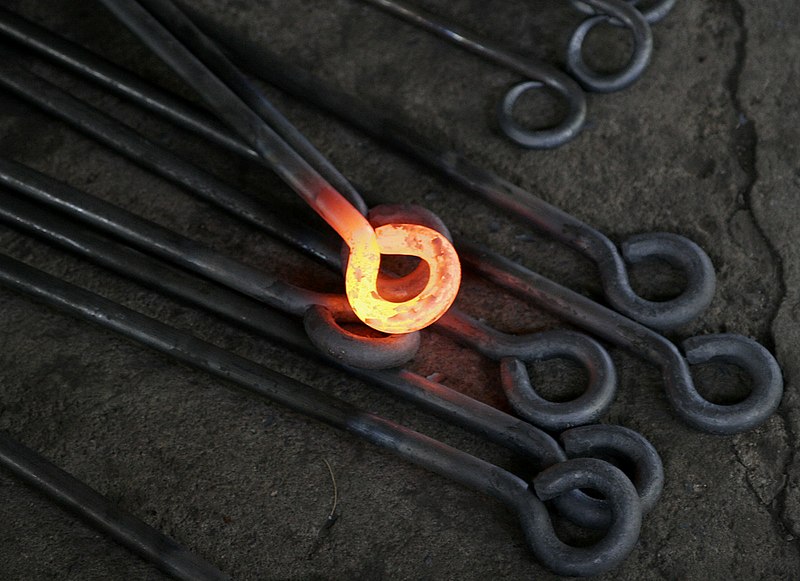
If you heat something up enough, you can start to see the radiation in visible wavelengths. This is why metal glows when you heat it up. It's also why incandescent light bulbs work.


Now you know how infrared light gives you extra information that visible light cannot give you. And you now know what thermal radiation is. Pretty cool huh?

Friday, October 7, 2011

Office Physics: Coffee Thermos


There are few worse feelings than when you come back to your coffee only to find out that it's luke warm. Sure you could microwave it, but something weird goes on there and makes the coffee less tasty than it would if it had never cooled in the first place (don't ask me why). Since I've never had a coffee maker at work, I've often solved this problem by putting my coffee in a thermos. They're wonderful inventions. They keep your coffee nice and hot for several hours if you have a good one. But how does it work?

It uses insulation. This is the exact same idea as when you put insulation in your attic. It's also the same idea as wearing ear muffs. Insulation is a barrier between a "hot reservoir" and a "cold reservoir." So when you put your coffee in the thermos, it is the hot reservoir and the air outside of the thermos is the cold reservoir.

When I say that insulation is a barrier, what I mean is that it slows down the transfer of heat. In the case of hot coffee, heat transfer is bad bad bad! I want my coffee to stay at the exact same perfect temperature until I've finished my last sip of coffee, gosh darn it! Sadly that's impossible. And sadly no thermos works perfectly. So if you leave coffee in a thermos long enough, it will eventually get to room temperature.

So why does heat have to transfer from a hot thing to a cold thing? It would make winter more enjoyable for me if all that cold air didn't suck all the heat out of my body. I think there are different ways to answer the question. You need to understand what temperature is first.

Temperature is (for our purposes) a measurement of how fast the molecules are moving around randomly. If the air around you is hot, the air molecules are moving around very rapidly, bouncing off one another in a random way. If the air around you is cold, then the air molecules are still bouncing around off one another randomly, but much slower.

So when your energetic warm skin molecules come into contact with the slow, cold air molecules, the energy is transferred to the air molecules, warming them up and cooling you down. Same idea as billiard balls. The energy in the cue ball is transferred to the other balls when it runs into them.

That's heat conduction, which is part of the reason your coffee gets cool. The coffee heats up the air it's in contact with. But the second form of heat transfer, called convection, is probably the most important reason your coffee gets cool.

Heat conducts more slowly when the temperature difference between the two reservoirs is small. So as your coffee heats up a particular group of air molecules, it has a harder and harder time dumping the heat into them. But the problem is that the air that's been heated up will get out of the way and make room for fresh, cool air to absorb the heat. So conduction and convection work together to cool down your coffee.

Air molecules are actually really bad at conducting heat, which is the same thing as saying that air is a good insulator. So it turns out that you could solve most of the problem by eliminating convection--to figure out a way to keep the air from moving around a whole lot. So for coffee thermoses, a metal shell is placed around the core so that there is a thin layer of air between the two metal cylinders. This keeps the air from moving around too much and slows down the heat transfer.

So that solves the problem. Now we can enjoy our hot coffee.

Sunday, September 11, 2011

Why Walking South Would Feel Like Walking Downhill if the Earth was a Perfect Sphere

As Treebeard in Lord of the Rings says, "I always like going south; somehow, it feels like going downhill."

Well I decided to put this to test and actually figure out if walking south actually feels like going downhill and that it's not completely psychological. I'm going to solve this problem assuming the earth is a perfect sphere. This is not a true assumption, so make sure you read the Edit section at the bottom of this page.

If you're going to solve this problem, you should draw a picture. In physics, we like to draw free-body-diagrams that show all the forces acting on the thing that matters. In our case, the thing that matters is a man standing on the surface of the earth. Pointing outward from his body are two arrows that show the forces acting on him (at least the only ones I care about).


So gravity is pulling down on the man and I called it Fg. There's another arrow called Fc. This represents centrifugal force. Centrifugal force is only an apparent force. Believe it or not, your body doesn't want to spin around in circles all day, every day. It wants to keep moving in a straight line. But gravity is strong enough that it keeps you on the ground, moving in circles (much to your body's chagrin) for all eternity. So because the earth is spinning you experience an apparent centrifugal force, think Gravitron.

Well we just might be in luck, because look at the direction the centrifugal force is pulling. It's not pulling straight up or straight down. It's pulling you both upward and south, towards the equator!

So the feeling of walking downhill while you're walking south is not 100% psychological. It might be 99.999999% psychological, but by golly, it's not 100% (at least in 99.99999999% of the cases).

The next question to ask is, How strong is this "Downhill Force" at different latitudes? Is it stronger at the poles or at the equator or somewhere in between?

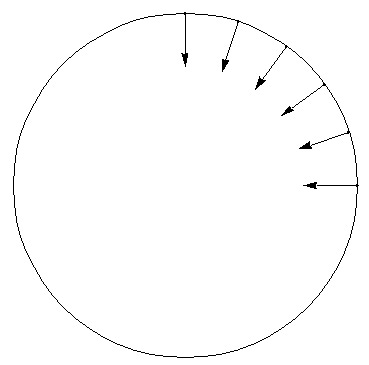
Well I did some calculations and drew this picture which shows the total force on someone at various latitudes in the northern hemisphere, taking into account both gravity and the centrifugal force.
It pretty much just looks like you'd be pulled towards the center of the earth at any latitude. But instead of looking at the total force, let's look at the tangential force. The tangential force is the force pushing you either north or south (not up or down). Here is a similar picture plotting only the tangential force and ignoring the vertical forces.

If you look closely, you'll see points at 0, 18, 36, 54, 72, and 90 degrees. But there are no arrows coming out of the points at 0 and 90 degrees and the forces in between are the strongest. This makes sense. If you're on the north pole, there is very little centrifugal force since you're close to the axis of rotation. If you're on the equator, you have the most centrifugal force, but unfortunately, it's all pointing straight up into the air, which doesn't help push you forward. In the next figure, I've plotted the tangential force as a function of latitude, including the southern hemisphere.


So the places with the most tangential force are at + and - 45 degrees latitude. And it turns out that if you're in the southern hemisphere, walking north feels like walking downhill. For reference points, I've plotted where New Orleans, Denver, Portland, and Anchorage lie. Lucky Portlanders get maximum downhill force. And my parents who recently moved from Anchorage area to New Orleans can happily say they at least didn't forfeit any downhill force by their recent move.

Although, probably the most important thing to look at on that graph is the vertical axis, which is measured in G's. So that means that even in Portland, OR, you only get a maximum downhill force of about 2/1000 of your body weight. Sad day.

Edit:
Below, Wintergreen pointed out that the shape of the earth is not exactly spherical. The shape of the earth is determined both by gravity and by the centrifugal force. So that means that the earth is somewhat flattened. The equilibrium shape of the earth would be one where the surface is always perpendicular to the combined force of gravity and the centrifugal force. That means that if the earth has reached that equilibrium shape, then there is no "Downhill Force." The downhill force would only exist before the earth has reached that equilibrium shape. 

Wednesday, April 13, 2011

Office Physics: The Laser Pointer

The original laser pointer

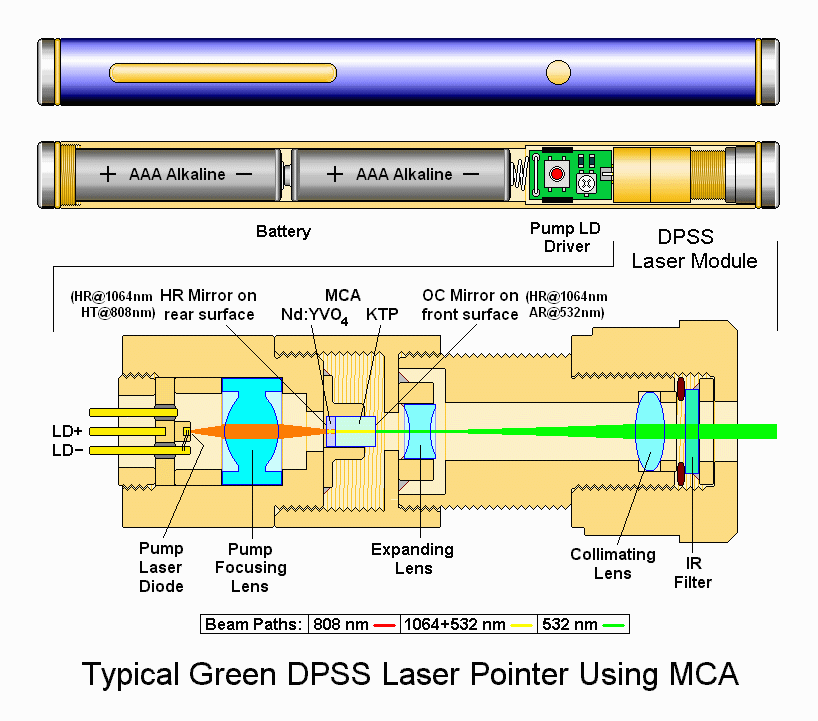
Back in the days of star trek, the laser was first discovered. They were first used as weapons for obliterating alien space ships. Much like guns, they had amazing accuracy, which was valuable for combat and lecturing. In the ancient days, guns were used for pointers in the classroom. The teacher would pull out her revolver, and shoot wherever on the board she wanted to point. The accuracy was impeccable, but it caused a disruption in the neighboring classroom the first day it was used and was never used again. From then on, wooden pointing sticks were used even though they were helplessly inaccurate. When laser guns came around one anonymous entrepreneur realized they could be used in the classroom for pointers. Luckily he had spent several years scouring the microfiches of thousands of libraries and came across the story of the teacher using a gun for a pointer. So he decided to make a laser pointer with lower power so as not to damage the young minds he taught. The laser pointer has evolved some over time, but here's a diagram of what the modern green laser pointer looks like:
There are three important parts to a laser.

1. The pump: This just a light with a single color. It could be a laser, an LED, a laser diode, whatever. In the case of this laser pointer, the pump is a laser diode with a wavelength of 808nm. It's effectively just a red light bulb. The light from the pump is sent through a focusing lens, into the resonant cavity.
A laser pump

2. The resonant cavity: The resonant cavity is made of two mirrors and inside the resonant cavity sits a material called the gain medium. If the separation between the two mirrors is right, then one particular wavelength of light will resonate in the cavity and will cause the output light to be very intense. The resonant cavity's job is to allow only one wavelength of light to pass through the gain medium several times, so that you only get one color of light coming out the other side.

A resonant cavity for kids

3. The gain medium: The gain medium is some material that's placed inside the resonant cavity so that the right wavelength of light comes out the other side and it causes the intensity to increase. In the case of this green laser pointer, there's two materials inside the cavity. One is Nd:YVO4, which is used to create infrared 1064nm light. What happens in this step is that high energy (red) light comes in and is absorbed by electrons in the crystal. This left the electrons with a high energy for a bit. The electrons soon decide to release their energy in the form of a photon of wavelength 1064nm. After converting the light into 1064nm, the light goes into the KTP crystal. This is a nonlinear crystal, which means that it acts differently for different intensities of light. Inside the KTP crystal, a process called second harmonic generation happens. This picture shows how it works:

One low energy photon comes in and excites an electron to a higher energy state--an energy of E. Immediately, a second identical photon comes in and excites the electron to a higher energy to an energy of 2E. Like before, this electron decides to relax and gives off a photon with twice the energy of the original photons. This gives a photon coming out that is half the wavelength of the infrared photon, so you get a green light with wavelength 532nm (half of 1064nm).

The green light is expanded and collimated so you get a nice green beam coming out the laser pointer. Tada!

If you made it this far, you probably know more than you ever wanted to know about a laser pointer.

Wednesday, March 9, 2011

An Excessively Nerdy Post About Spectra

Recently I've been doing a lot of ellipsometry. Ellipsometry reflects a laser off of a thin film and measures how the phase of the horizontal and vertical polarizations change after reflection. If you do it right, this gives you information about how thick the thin film is and what its index of refraction is. Part of ellipsometry is being able to look at a graph of n and k (the real and imaginary parts of the refractive index) and to identify different processes that are happening in the material. A good ellipsometer scientist can look at an n and k spectrum of Gold and say, "Oh those are free electrons over there and over on this part of the spectrum that's two different electron transitions." They can look at a spectrum and extract lots of information from it.

Here's a great example. For no particular reason, I went to Google and typed the letter a, wrote down how many Google hits it had, then moved on to typing aa, et cetera, all the way to 100 a's.

Lots of information can be extracted from this graph.

The first and most obvious piece of information should be the that Jon Banks has lots of patience and/or is incredibly obsessive over proving a point. This is pretty evident in the amount of time it would take to perform this study.

You can also look at the graph and learn about how people tend not to like to hold down the "a" key for all that long. They get tired of it eventually. This is indicated by the general downward trend, decreasing toward zero. However, there's always some freak that holds the "a" key for 5 days and then posts it somewhere.

If you look at a^72 there's a huge spike. Normally, my first guess would be that it is an outlier. But if you go to Google and type 72 a's, you will find that there are quite a few hits at that particular number of a's. So it is consistent, therefore it is real. This indicates to me that a particular group of people is incredibly obsessed with 72 a's. Or maybe some amazing video on youtube has a comment with 72 a's.

One of my favorite parts of experimental physics is looking at a spectrum and extracting all kinds of information from it.

Thursday, February 3, 2011

Why that darned contraption with two wheels won't fall over

When I was a senior in high school, I took my first physics class. It was A.P. Physics from a man named Mr. Soandso. It was a great class. We had lots of fun labs and it made me realize I might want to be a physics major. But here I am six years later, remembering something he told us that was incorrect.

One day somebody asked him, "How can you stay balanced so easily on your bike when it's moving?" It's hard to balance while you're standing still on a bike, but ridiculously easy if you're moving. He told us that it was because of the wind moving on either side of us that kept us balanced as we moved. That didn't make much sense to me, but I accepted it and moved on in life. Years later I realized that was wrong, or at most has only a small effect on the balance.

It really is quite amazing that we can ride on two very narrow wheels and not just tip over. The tires on my Bianchi are only 2.5cm wide, so they're definitely not helping me have a nice stable footing. If you remember my recent post about the conservation of angular momentum of a swivel chair, the problem of a bike's stability is also an angular momentum problem.

If you own a bike, take off the front wheel and do this experiment. If you teach a class, show this to your kids. Take the wheel so you're holding the axle in both hands. Spin the wheel on the ground or have a friend spin it for you. If you hold it in front of you so the wheel is still vertical, it will feel about like you'd expect. It feels no different from holding the wheel up in the air while it wasn't spinning. Now try to turn the axle and be careful. The wheel will resist your attempt to turn it.

That's exactly what's happening when you ride your bike. Your wheels start spinning around an axis and then they resist turning when you try to fall to one side. Now if you wear clip-less pedals, you can certainly feel the lack of resistance when you slow down to a stop, forget to clip out of your pedals, and promptly fall to your side in front of the pretty girl in the car next to you. Angular momentum helps you get the ladies.

Angular momentum also helps you turn on a bike. When you're going slow, you just turn your wheel and the friction causes your bike to turn-that's boring. But when you're going fast and try to turn, you'll notice that you're barely even turning the front wheel, if at all. You just lean to one side and you turn that way.

Here's another experiment you can do that helps you understand how you turn on a bike. Grab your front wheel again and get it spinning while holding both sides of the axle. Now take one hand off and just hold one side of the axle with one hand. First of all, you'll notice that it stays pretty much upright. That's pretty cool, but you'll also notice that its weight has caused it to tilt to the side just a bit. The last thing you'll notice is that the wheel actually starts to turn. You'll feel really silly because you'll have to keep repositioning your body so the wheel can keep turning. By allowing the wheel's weight to tip it to the side a bit, the wheel naturally turns.

This is the same thing that's happening when you turn on a bike. You tilt the wheel just a little bit and it applies a torque to the whole bike, making it turn.

Here's the technical version of why this works:
The civil engineers know that torque is r cross F. The mechanical engineers and physics peeps know that torque also equals the time derivative of the angular momentum vector. The civils are left tapping their heads because they've never seen a lower case t in an equation before. But all it means is that if you change your angular momentum, you get a torque. The direction of the wheel's angular momentum is along the axle. If you change the angle of the axle, you will get a torque in the direction of the change (note that the L is a vector, not a scalar). So if you tilt the axle to the right, the wheel will turn to the right. Get it?

Hopefully this tidbit of knowledge will help you remember to unclip from your pedals when you're at an intersection next to a pretty girl (unless you have mad trackstand skills). Hopefully this will also prevent you from inventing a bicycle that has two wheels side by side. It won't work.

Monday, January 31, 2011

Office Physics: The Swivel Chair

Most people look at offices and think, This place is totally lacking cool physics. No lasers, no microscopes. Just a bunch of desks, computers, and chairs. I've never given any tours of my office, but I have given several tours of my labs (if you ever want one, I'd be happy to give you a tour).

But today, during my first 15 minutes of my lunch break I decided to change this view. Surely there is some interesting physics going on even here in this dingy office. I looked around the room and was amazed by what I saw: A bunch of desks, computers, and chairs. Still a lame office. I turned around in my swivel chair to throw my orange peel in the trash can and my eyes were opened to one of the most wonderful objects in the office: The Swivel Chair.

So there I was, eating a delicious orange, thinking about the fiber that's found in the peal. It would be very healthy for me to eat, but I chose to throw it away like any self-respecting American would do. I also thought about how if I was on a mountain, starving in a snowstorm, I would have eaten every single bit of that orange. But thank God, I'm not stranded on a mountain.

So I turned my swivel chair so I could throw away the peal. Mid rotation, I realized that I was spinning way too fast! My heart pounded and my forehead started to sweat, thinking about how embarrassing it would be if I couldn't stop myself before ramming right into the divider. My coworkers would surely ridicule me for the rest of my life. It was at that moment, just in the nick of time, that I remembered a very important lesson I learned in physics 1: Conservation of Angular Momentum.

In times of survival, while the adrenaline is rushing, your brain operates much faster than normal. This was my situation. I was to become either Dwight Schrute or Jim Halpert (which is no different from a life or death situation). Faster than ever, my brain calculated how I could change my body so that I could slow down before disaster. The solution to the equation was to stick my legs out. I slowed down so that I could gently place my feet against the neighboring desk without disturbing anyone. I quietly dropped my orange peal into the can and carefully turned back to write about the experience.

Conservation of angular momentum says that angular momentum is conserved. Please don't be shocked. When you spin yourself in your swivel chair, you're giving your body angular momentum. Angular momentum is dependent on your moment of inertia and your speed of rotation. Since angular momentum is always conserved you can only trade off between moment of inertia and speed. If you want to spin fast, you must reduce your moment of inertia by bringing your legs inward. If you want to slow down, you must increase your moment of inertia by stretching your legs out.

Hopefully this tidbit of knowledge will save your life someday.

Saturday, January 1, 2011

How to tell the difference between a man and a woman

I' m always amazed to see amazing technologies that exist in nature. You can just look at yourself and find a lot of them, although I wouldn't recommend operating on yourself for the sake of marveling at your heart. The most recent thing I've learned about is the lyrebird. They can imitate any sound they hear. It's pretty amazing hearing them imitating all kinds of other birds, but they also imitate chain saws, car alarms, and cameras (at least in the link above). It's pretty amazing what they can do.

Humans aren't all that bad at it either though. If you know how to speak english, then you can do this to an extent. If you can speak several different languages, getting the accent right every time, then you're pretty much amazing. When you look at the basics of what's going on when we do this, I think it's quite impressive.

If you heard the word, flabbergasted, then you can recognize it and probably know that it means exhausted. You could also hear two recordings of the word, one by an Englishman and one by an American woman and probably distinguish the two.

Now here's a fun-filled quiz: Which audio sample is the Englishman and which is the American Woman?

You guessed it. Audio sample 1 is the American woman and audio sample 2 is the Englishman. Now let's look at what your ear heard when you played those audio samples.
If you compare the two samples, you can see that they actually look pretty similar. The top line of both images gives you an idea of the rhythm of the syllables and the emphasis on particular syllables. On the second and third lines you see more detail. It's pretty easy to see in the second line that the frequency of the woman's voice is higher than the man's voice, hence your ability to tell that one was a woman and one was a man. Also, your brain has some way of recognizing which waveforms make the sounds fla-bber-gas-ted. I guess by looking at the higher frequencies. And then, to top it all off, your brain can look at the sounds each letter makes and tell the tiny differences between an American and English accent.

It's pretty impressive what your ear can do. And then if you can turn around and mimic the word and the accents, then it's even more impressive.

Tuesday, November 23, 2010

Drinking Tea is a Lot Like Quantum Mechanics


One of my favorite subjects in physics is Quantum Mechanics. I'm going to tell you about a very famous quantum mechanics problem called the Finite Quantum Well, also called Particle in a Box.

If you have ever drank out of a cup with a flat bottom and vertical walls then you have observed this problem in real life.

If you pull out a Celestial Seasonings tea bag (Any kind of "Zinger" is an excellent choice as well as most of their herbal teas. I'm not much of a green/black/white tea kinda guy) and put it in hot water, here's something to do while it's brewing: Tap the cup and watch the water. You'll see different "modes". One mode that you'll see just has one bump in the middle, going up and down. That's the first order. Second order is one with two oscillating bumps to each side. It get's really complicated really fast because fluid mechanics is ridiculous, but I'll just talk about the first 2 modes.

When you tap the cup, you give the liquid a kinetic energy. If you give it too much energy then the water will splash out of the cup, burning you with scalding hot water. You'll scream in pain, such on your hand for a while, and maybe even go over to the sink to rinse it with cold water. The more energy you give the water, the higher order modes you will get and the higher the water gets.

The cup provides potential energy. The further out you go, the higher the potential energy gets. Since the energy goes up as you go out, you get a stable equilibrium, meaning the water stays in the cup pretty well. If you put a cup upside down it won't have a stable equilibrium anymore since the energy goes down as you go out. The only way for water to get out of the cup is if it has more kinetic energy than the walls have potential energy, thus causing the burning hot splash.

In quantum, instead of having water in a cup, you have a particle in a box. The box has potential energy walls just like the cup and keeps the particle inside the box pretty well. You have modes just like the water in the cup. The lowest energy mode says that you will most likely find the particle in the center of the well. The second order mode says that you will either find the particle on one side or the other, just like the two oscillating bumps.

The most significant difference between these two problems is that quantum says that there's a probability you will find the particle outside the box for a single particle in a box with thin walls. If you had a quantum well shaped exactly like a coffee cup sitting on a table, then eventually the particle in the well will leak out, which is called tunneling. In terms of the water in a cup problem, this is essentially saying that if your cup sits there long enough then the water will leak out the sides (note that I didn't say it would spill over the top, which is the only way for your tea to leave your cup).

It sounds crazy, but it's true. And don't worry, it won't be long till your tea is done brewing.

In quantum, particles are described by a "wave function." If you square the wave function you get the probability distribution of the particle. You have all seen a bell curve, so when I say probability distribution, think about a bell curve. A very famous equation called Schroedinger's equation tells you all the wave functions for a given quantum well. If you write out an equation for the shape of a coffee cup and plug it into Schroedinger's equation, then you can solve for the wave function of that particular well (assuming you know how to solve differential equations). If you did this then you would see a bell curve for the first order mode. The tails of the curve would extend outside of the well, telling you that there's a probability of finding the particle outside of the well. What I'll mention in passing is that if the walls of your coffee cup are much thicker then a few nanometers, then the probability is mind bogglingly low. I assure you that nanoscientists are currently working on building a coffee cup with 3nm walls, so pretty soon you can buy your own quantum well coffee cup.

So now you know what a quantum well and a wave function are. They're pretty cool. You may drink your tea now.

Monday, November 15, 2010

Thank God for Gravity

I was feeling bike withdrawals yesterday because I hadn't ridden my bike in over a week due to the cold weather and my wimpiness. I decided to take my bike on the bus out to Golden for church and then ride my bike back. It was very refreshing. Just like eating a pumpkin pie when it's been a year since the last time you had one.

Usually I don't think about a whole lot when I ride my bike, but this time I was feeling incredibly contemplative. For whatever reason I started thinking about a world without gravity and how different riding a bike would be in this world.

Imagine this floaty world and a flat plane that you needed to get across, say to go to the grocery store. Suppose you had some sort of bike railroad that kept your wheels attached to a rail so you wouldn't float off. It would be very weird.

You would start to pedal, but every time you pushed down your body would move up a lot and your bike wouldn't go forward as well. You need something to push against and on Earth we have gravity to push against to push our pedals.

It would be much more natural to get clipless pedals and do a lot more pulling than pushing like we do these days. Cyclists would develop different muscles. Their quads wouldn't be quite so epic and whatever the muscle that operates the hamstring is would be much more epic.

Crashes would be a bit less devastating. You wouldn't ever fall to the ground, but if you flew off your bike and headed towards a wall or other hard object, it would be just as painful as running into a wall with gravity.

It saddens me to think about this because it just doesn't seem very intuitive for a gravitiless world to have bicycles. I don't think the bike ever would have ever been discovered if we had no gravity. Technological natural selection probably would have never gotten to the point of making a bicycle. Any form of bicycle would have likely evolved to a completely different machine, not resembling a bicycle in a world with gravity.

Perhaps there would be an equally fun and useful machine in this gravitiless world, but for now thank God for gravity because it means we can ride bikes.

Friday, November 12, 2010

How to travel in time: Expansion and contraction of possibilities space

As you may know, November 12 is a very important date. It will forever be the iconic date people will think of when they think of time travel. In all seriousness, it should be November 5th, but V for Vendetta went back in time and stole that date before Back to the Future could really claim it. November 5th was the day Marty went back in time and November 12th was the day he came "back to the future." Not only is this one of the best movies of all time, it is also one of the greatest discussions on Time Travel Philosophy.Today's blog post is dedicated to this topic.

Traveling in time is of course impossible. At least any useful time travel. Special relativity says that if you go really fast then return to your planet you will have aged much faster than your Earthling peers. This is about as interesting as it gets. This is just a nuisance and, to my knowledge, is not very useful. Using special relativity you can do tricks with time so that it moves at a different rate than other times, but there is no way to actually go back in time according to modern science (that I'm aware of).

While this is sad, you may have read my post explaining the Banksian Sphere, which challenges humanity to adopt new ways of thinking. This suggests that we may be able to discover time travel if we simply go at it from a completely different direction than simple scientists would. This means that time travel may still be possible using alternate dimensions or other methods, but we just haven't discovered it yet. That being said, we can continue our one sided philosophical discussion.

I think that deja vus are really cool. I love it when I get one because for a minute you feel like you have the superpower of predicting the future. It feels like sometime a long time ago you predicted that this situation would happen. I would claim (using my Banksian Sphere (B.S.) methodology) that you never predicted the future and that it is also not just a mind trick. But rather, it is the extreme deformation of possibilities of reality, allowing one part of the universe to come near to the universe at some time in the past. If you have an infinite dimensional "possibilities space" with infinite possibilities of outcomes for the universe traveling along a single time axis, then it would be possible for a certain point in the "possibilities space" to line up with the same point at a time in the past. This would be possible if the timeline loops back so it's close to where it was before or if the possibilities space expands an contracts throughout time.

I would tend to believe the expansion and contraction theory. If the possibilities space expands and contracts, then it means that it would take more or less effort to go from one point to another. For instance, in this part of the universe (Denver, CO, USA, Earth, Milky Way...mmm milky way) it is very easy for me to fill up my water bottle and drink clean water. A few thousand years ago, it was much more difficult to go from point one (sitting in my chair) to point two (sitting in my chair drinking clean water). These two points in possibilities space have come closer to each other over time. Contrarily, it was much easier to find a record player at the store 40 years ago than it is today. The two points of not having a record player and having a record player have gotten farther apart.

You can see that the naturalness of going from one point to another in possibilities space is not necessarily constant (and not necessarily varying either). I don't currently have any evidence that time loops back on itself, but I'd be interested in hearing theories on that. So if you believe my scientifically flawed argument for the expansion and contraction of possibilities space, then you can easily deduce the possibility of time travel. If a possibility line expands so much that it actually spreads back to the same possibility at a different time, then it may be possible to travel in time.

I hope this inspires all you peeps to figure out how to travel in time.


I wouldn't believe me if I were you. I'm starting to feel ashamed of my weird ideas that should be a disgrace to science.

Tuesday, November 2, 2010

Alternate Dimensions

If you are my friend, which these days is defined by whether or not we are "Facebook Friends," then you may have seen this suspicious photo on my "wall" or "muro" if your Facebook is in Spanish like mine.
Here I mention a supposed "Discrete Fourier Transform." If you don't know what a Fourier Transform (FT) is, the most important thing to know is that it's pronounced For-yay. The second most important thing to know is that it's cool and gets all sorts of engineers and scientists excited. If you read my note way back when about shadows and projections, then you saw how nerdy I got about them. Well if you think projections are exciting then you'll think FTs are even more exciting...because, well, they are a kind of projection.

A shadow is a position projection. If you look at your shadow, it gives a half way decent description of the position your body is in. You can at least tell that you're standing. It may be missing some information, but it takes the real position of your body and projects it onto a horizontal plane.

A Fourier Transform is a frequency projection. It takes something with lots of frequencies and projects them onto reciprocal space. This tells you how much of each frequency is in the signal.

If you speak into a microphone, then your voice most likely has several frequencies in it. Try saying "Red Rum" in the same way that creepy kid in The Shining says it. His scratchy voice has lots of frequencies in it. Some low pitches and some high pitches. If you're singing (assuming you're a half-way decent singer), then the majority of the frequencies are sitting at whatever pitch you're singing. If you sing an A, then you could take the FT of your voice and it would tell you that there is a strong signal at a frequency of 440Hz. Unless your voice sounds a lot like a tuning fork, then it will have some other frequencies in it. Mostly random vibrations caused by your throat and mouth and lungs and who knows what else. Hopefully this explains what a FT is well enough.

The reason I get excited about Fourier Transforms (and other transforms) is that it's like exploring a new dimension! I mentioned that a FT projects a signal into Reciprocal Space. Reciprocal space is another set of dimensions where you can walk around, but instead of walking from position to position, you walk from frequency to frequency.

Now, your voice is a one dimensional signal. It just oscillates the paper in the microphone back and forth, so basically between -1 and 1 on a number line. The reciprocal space of a microphone vibrating is just a line. If your friend was singing into the microphone and you were walking around it's reciprocal space you would see it get really bright at whatever frequency she was singing at. All the frequencies would just fall along one line.

Now, if you took a picture of your pet cat, like the stray that my friends at the Den adopted for a day (hopefully she's gone by now), you would have a 2 dimensional signal. Pretend you were feeling artistic and made the photo gray-scale. You could look around the picture and see that some locations are brighter than others. Even though this signal is a picture, you can still think of it as a signal with lots of frequencies. Instead of the vibration of air, the image's frequencies are determined by how the brightness changes as you go across the picture. So if you have a 2 dimensional signal like an image, then you can take a FT of it and it would give you a 2 D reciprocal space that describes the frequencies in your signal.

Well, I was feeling particularly adventurous and did that with that picture of that cat at the top. There's a very pretty gray-scale photo of the cat followed by a painfully boring image that is it's FT in reciprocal space. That's right, ladies and gentlemen, that second picture is what a cat looks like in reciprocal space. I imagine it's pretty hard to tell the difference between a cat and a dog in reciprocal space.

You may say, Holy cow that's boring, but how on earth could you get back to normal space after getting transformed into reciprocal space? All you have to do is have someone take an Inverse Fourier Tranform and you're back in normal space. If you look at the top you see that the Inverse FT photo looks a lot like a possessed cat. The only reason the colors are inverted is because Mathematica wasn't consistent in its conventions. If it did the IFT correctly, it would have returned a normal looking picture of a cat. So you now know how to travel to this ultra-boring reciprocal space and then return back to normal space when we're talking about 1D or 2D. I just think it's pretty crazy that the cat turns into something as boring as that middle picture and it still has the same information that it originally had. P.S. the reason why there's no loss of information in this projection is that a FT takes an infinite number of projections and puts them together.

3D Fourier transforms are also possible. It's just like 1D and 2D only everything isn't infinitely narrow or infinitely flat. One very interesting application of 3D Fourier Transforms is X-ray diffraction, which can be used to shoot x-rays at a grain of salt and verify that it is indeed salt without even having to taste it. Most people in the world would just taste it to find out that it's salt, but engineers and scientists like to make things more difficult than they need to be. So they shoot x-rays at it to figure out its crystal structure. Just like sound and images, you take take a FT of a crystal lattice and it gives you a 3D reciprocal space that also looks like a crystal lattice, just a different structure. If you shoot x-rays at a crystal, then the x-rays diffract off the crystal and spread out in their frequencies. Depending on the crystal structure, different frequencies of x-rays will diffract to different locations. When you detect different frequencies of x-rays at different locations, you're basically measuring something very similar to the crystal lattice's Fourier transform and you're looking at it in reciprocal space. Then if you take the IFT of this diffraction then you can figure out that salt has a crystal structure of face-centered-cubic. (Molecules forming the corners of a bunch of cubes with an extra molecule at the center of each cube face).

You may think this was incredibly boring, but this is basically why engineers and scientists think that Fourier Transforms are so great...Travelling to alternate dimensions.

Saturday, October 2, 2010

Physics is Cool

Note: I posted a bunch of old notes that were originally on Facebook. So if you ever care to go back and check them out, they're in the process of appearing in the archives.

Most of you guys reading this know that I study physics. I just finished school 3 weeks ago and now do research at Mines. I decided I would write a post about the physics that I study because I think it's pretty cool stuff.

If you were to ask me what kind of physics I study, I would say, Integrated Optics. This means that I study really simple optical devices that are built into chips on a really small scale. There's a billion different optical devices that can be built and they have all kinds of applications. I'll just choose one of the devices our group works on to give you an idea of the stuff I work on. I've probably worked on upwards of 10 different devices though.

Optical devices manipulate light in different ways for some application. The physics I do is extremely applied, so I don't do that crazy, revolutionary physics that you hear about in the news. Some things that you can do with light are emitting, detecting, filtering, guiding, measure polarization, and more.

Some familiar examples of these processes: (Keep in mind that when I say light, I mean Electromagnetic Radiation which includes, X-rays, UV, Visible, Infrared, Radio Waves, etc.)
  • Emitting: Light Bulbs, LEDs, Stars, Antennae, Cell Phones, etc.
  • Detecting: Eyes, Cameras, Antennae, Cell Phones, X-rays at the dentist, Radios
  • Filtering: 3D glasses (one eye mostly sees blue and the other eye mostly sees red)
  • Guiding: Fiber Optics, Those cool lamps that send light through fibers
  • Measure Polarization: Polarized Sunglasses, Camera Polarizer
So, our research group tries to do all these effects to build really small devices on micro chips (small=100nm-100microns). 70 microns is somewhere near the diameter of human hair.

One really good example of why these need to be so small is the Polarimeter project we're working on. A polarimeter can measure the polarization of light. You can have linear polarization, circular polarization, or elliptical polarization and the polarimeter can measure any of those and detect how elliptical the polarization is. If you've ever worn polarized sunglasses at a lake or river, then you know that the polarization of the light reflected off a surface tells you about the surface. Reflected light on the smooth, horizontal surface of water, is polarized in one direction and if you're wearing polarized sunglasses, standing straight up, you don't see the reflected light and you can see underwater better. If you rotate your head then you can start to see the reflected light and if you adjust your head so the reflected light is very low, then you have adjusted your polarizers so they are perpendicular to the surface. So by finding this spot, it gives you information about the angle of the water surface. The idea behind the polarimeter is to be able to do a similar measurement, giving the U.S. Army better information about the surface they are looking at.

So the Army wants this to be really small so they can make an entire array of polarimeters so each pixel in the digital camera can measure polarization. I don't know how many pixels they're planning on, but if we can make the polarimeter the size of the pixels on your computer then you can have an entire screen with really good resolution, where each pixel can measure polarization giving you a ton of new information that a regular old camera could not give you. That's why the device needs to be really small, so you can stack a bunch of them in an array to have many pixels.

The idea for a polarimeter is to filter out different kinds of polarizations of light in different ways to be able to measure what that polarization is. This actually isn't a project that I'm really working on, so I don't know that much about it. But it uses gratings etched in materials like Silicon, Silicon Dioxide, Silicon Nitride, Aluminum, etc. to couple different polarizations into a waveguide and sent out for detection. There are different shapes of gratings that filter out different polarizations so we can measure any polarization state. And all of this is built on a very small chip and I think the footprint for this entire device is under 100microns.

You now have some idea of the kind of things I work with. It's really interesting stuff and it's pretty exciting to be working on such advanced technologies. I'm very fortunate to get to work in this area of research because it is incredibly valuable.

This may have been a very boring post for some of you, but I don't care.

Song of the Day: Belated Promise Ring by Iron and Wine

Sunday, September 5, 2010

Just admit it...You know the trumpet is the best

Ask any serious trumpet player and they will undoubtedly tell you that the trumpet is the best instrument ever. This is one of those band stereotypes that are totally true! Maybe some day I'll write about band stereotypes like how goofy trombone players are and how much percussion likes making ears bleed, but that'll be another day. Or maybe not, cuz there's not much to it. I'm here to tell you why trumpets are, in fact, the best.

I've used this trumpet since I was in 6th grade, so, like 12 years. It is my favorite instrument I own just because I've had it so long and I'm secretively proud that it's a Yamaha beginner's trumpet that I still used through college (Don't tell anyone). I would have bought a new trumpet if I had $1,000 lying around that I wasn't already using for survival in the deep woods of the Anchorage suburbs. I'm going to try to tell you a few stories that I have shared with this trumpet over the years to show you why the trumpet is so great.

In eighth grade I was a hot-shot, er I thought I was. I was in the Gruening Middle School Jazz Band and, let me tell you, we were good. We mastered classics like chatanooga choo-choo, La Bamba, In the Mood, and other such songs that I thought were the coolest jazz ever 'til I realized they're all not that amazing. Anyways, one day we got to skip class for half the day and go around to the elementary schools and show them our skills. I was certain they all thought we were amazing musicians and they all wanted to be just like us when they grew up. Some 5 little kids at Birchwood elementary shouted out to me when I was walking next to them, "Trumpets Rock!" This confirms the first fundamental of the trumpet's coolness: Everyone knows the trumpet rocks!

I never really understood the trumpet until I was a sophomore in high school in the jazz band at 6:30 in the morning (an hour of the morning a high schooler would only be conscious for for the sake of jazz). Good ole' Boysen told me, "Jon, you need to just play louder and don't give a crap whether the notes are right or not. So get your dad to let you in the church and play in the auditorium so you have to work hard to fill up the room with sound." Of course I never did this because no trumpet player would ever accept help from a trombone player (or anyone really). Don't tell anyone, but I started playing louder. I sucked as much air into my lungs that they could hold and just blared that trumpet. I finally started to get better and realized that trumpet parts are very often designed to just blare out notes really loud and it's not that big of a deal if it's wrong. This confirmed the second fundamental of the trumpet's coolness: Trumpets know how to play loud and it's essential for surviving

So back to the whole playing jazz at 6:30 in the morning. I woke up every day during the last 2 years of high school at 5:45 in the morning so I could play jazz. I wasn't really a morning person and my dad knew it, so one day on the ride to school he asked me why I was willing to wake up at 5:45 for jazz band. I told him that it was the only thing keeping me sane in high school. Honestly, I didn't like most of the people at my school and with my business in taking all honors classes and playing sports every year, the only refuge I had was band. Science and math classes were cool and I had a very small group of friends that I liked outside of band, but band was the only class I ever went to, looking forward to seeing the people. Maybe I'll explain why I didn't like the people at my high school (and why I feel bad about it now) some time later. All that said, band and being able to play jazz trumpet kept me sane through high school. Therefore: Playing the trumpet keeps one sane.

Now, possibly the only legitimate reason the trumpet is cool is because of it's simplicity (which it also shares with the tuba, trombone, and baritone). It is 3 buttons for goodness sake. Pianos have like 66, Saxes, Clarinets, Flutes, Oboes, Bassoons all have a bunch of buttons too. It's like a fixie. The simplicity is just beautiful. Why make the instrument have billions of buttons when your body has the ability to control a significant portion of pitch. On a fixie, you just have to have the ability to ride at different cadences if you want to ride at different speeds. On a trumpet, your lips just need to get tighter or looser if you want to make adjustments to pitch (you can also make all kinds of tones by adjusting your mouth in other ways too). So, The simplicity of the trumpet (and other brass) is beautiful.

That's probably enough for now. Most of the reasons I gave aren't actual reasons and you could easily destroy me in a debate about it. I just like the trumpet and you should too.